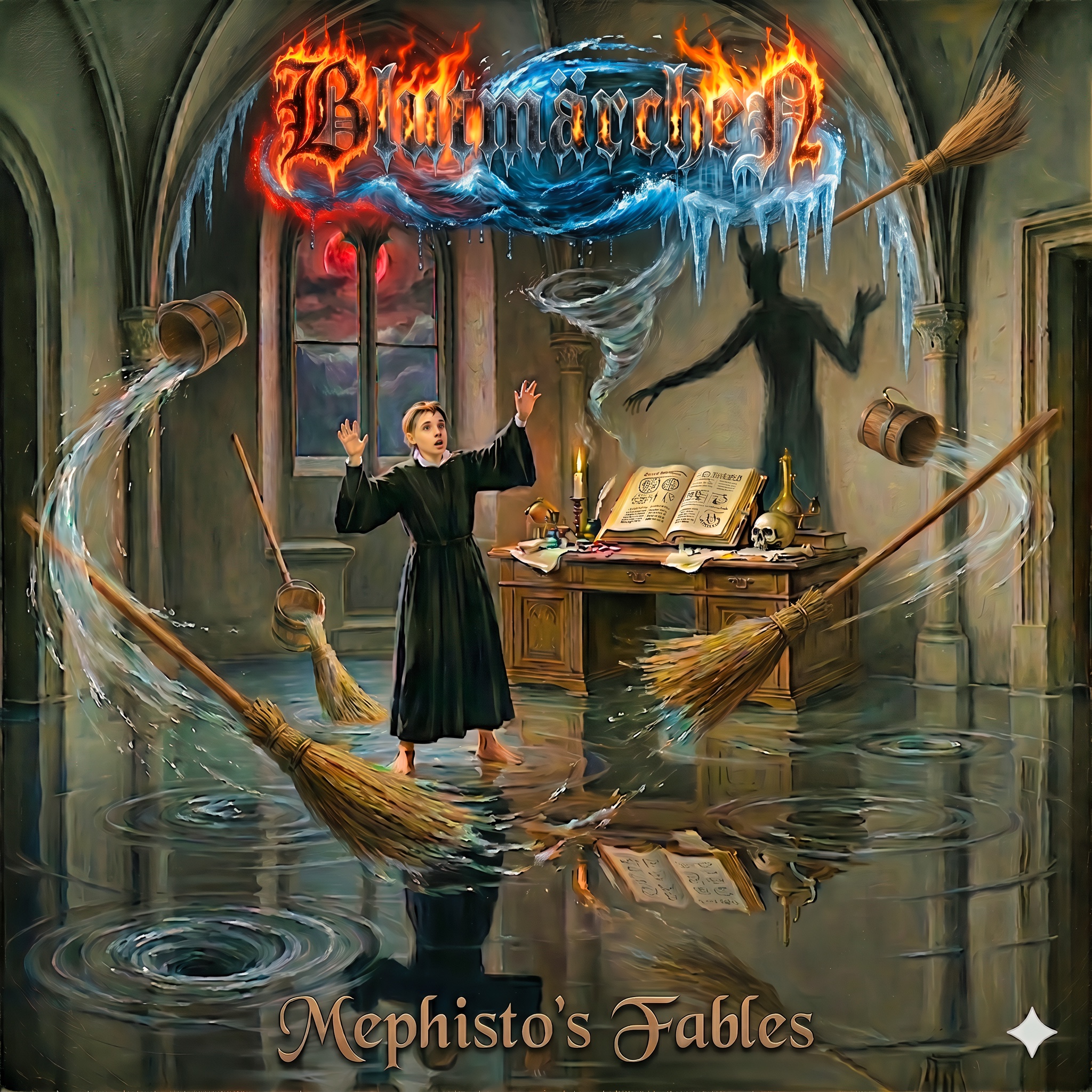
Blutmärchen
Twenty fables — told by the Devil himself. From Faust's first deed to Descartes' last doubt — Every hand that reached beyond its calling. Only the mind that asks survives the telling.
Die ich rief, die Geister, werd ich nun nicht los.— The spirits that I called — I cannot now get rid of them.
Goethe's ballad ends in chaos. This song stays past the ending and asks what the apprentice learned. The answer is hard. He is gone. The room is mine. The silence listens.
Part III interleaves Goethe's German verbatim with the apprentice's reckoning. The braid is deliberate: „Hat der alte Hexenmeister sich doch einmal wegbegeben…" — the original opening line, now spoken in retrospect. I know the signs. I know the word. I do not know the end. The pride that broke the room is named directly: PRIDE SPEAKS FIRST. What follows is not contrition but compression. The spell remembers motion, but not mercy. You can build a machine that runs forever. You cannot build one that knows when to stop without you knowing.
The lesson is the album's recurring shape — the gap between knowing how and knowing when. Faust signs the pact knowing how. Quixote charges windmills knowing how. The apprentice spills the floor knowing how. The lesson is the moment they each realize "how" was never the question. „IN DIE ECKE, BESEN, BESEN!" The master returns. The apprentice does not.
English
„Hat der alte Hexenmeister
sich doch einmal wegbegeben…“
He is gone.
The room is mine.
The silence listens.
I know the signs.
I know the word.
I do not know the end.
YOU KNOW
THE SPELL.
NOT
THE LAW.
„Und nun sollen seine Geister
auch nach meinem Willen leben.“
I speak and the room obeys.
I smile at the speed of it.
What moves so fast must be right.
What answers instantly must be true.
PRIDE
SPEAKS
FIRST.
„Walle! walle
manche Strecke…“
„Ach, das Wort, worauf am Ende
er das wird, was er gewesen!“
I call it back.
It does not listen.
The command returns… empty.
The spell remembers motion,
but not mercy.
YOU SPOKE
WITHOUT
RETURN.
„Die ich rief, die Geister,
werd’ ich nun nicht los.“
It multiplies.
Each strike creates another hand.
Each command becomes a flood.
This is not power.
This is hunger.
„Herr, die Not ist groß!
Die ich rief, die Geister,
werd’ ich nun nicht los!“
THIS
IS
THE
LESSON.
„IN DIE ECKE, BESEN, BESEN!“
Deutsch
„Hat der alte Hexenmeister
sich doch einmal wegbegeben…"
Er ist fort.
Das Zimmer gehört mir.
Die Stille lauscht.
Ich kenne die Zeichen.
Ich kenne das Wort.
Ich kenne nicht das Ende.
DU KENNST
DEN ZAUBER.
NICHT
DAS GESETZ.
„Und nun sollen seine Geister
auch nach meinem Willen leben."
Ich spreche, und das Zimmer gehorcht.
Ich lächle über die Geschwindigkeit davon.
Was sich so schnell bewegt, muss richtig sein.
Was sofort antwortet, muss wahr sein.
STOLZ
SPRICHT
ZUERST.
„Walle! walle
manche Strecke…"
„Ach, das Wort, worauf am Ende
er das wird, was er gewesen!"
Ich rufe es zurück.
Es hört nicht zu.
Der Befehl kehrt zurück… leer.
Der Zauber erinnert sich an die Bewegung,
aber nicht an die Gnade.
DU SPRACHST
OHNE
RÜCKKEHR.
„Die ich rief, die Geister,
werd' ich nun nicht los."
Er vervielfältigt sich.
Jeder Schlag erschafft eine weitere Hand.
Jeder Befehl wird zu einer Flut.
Dies ist keine Macht.
Dies ist Hunger.
„Herr, die Not ist groß!
Die ich rief, die Geister,
werd' ich nun nicht los!"
DIES
IST
DIE
LEKTION.
„IN DIE ECKE, BESEN, BESEN!"
- Artist
- Blutmärchen
- Song title
- IV — Der Zauberlehrling III — The Lesson (The Lesson)
- Album
- Mephisto's Fables — From the first deed to the last doubt
- Released
- 2026
- Genre
- Symphonic melodic death metal
- Country
- Luxembourg
- Label
- Self-released
- Rights
- © 2026 Blutmärchen — All rights reserved
Composed with AI-assisted arrangement (Suno, licensed for commercial use), performed and produced under human direction. Full disclosure →
Want to contribute a real performance to a future tale? Read the call →