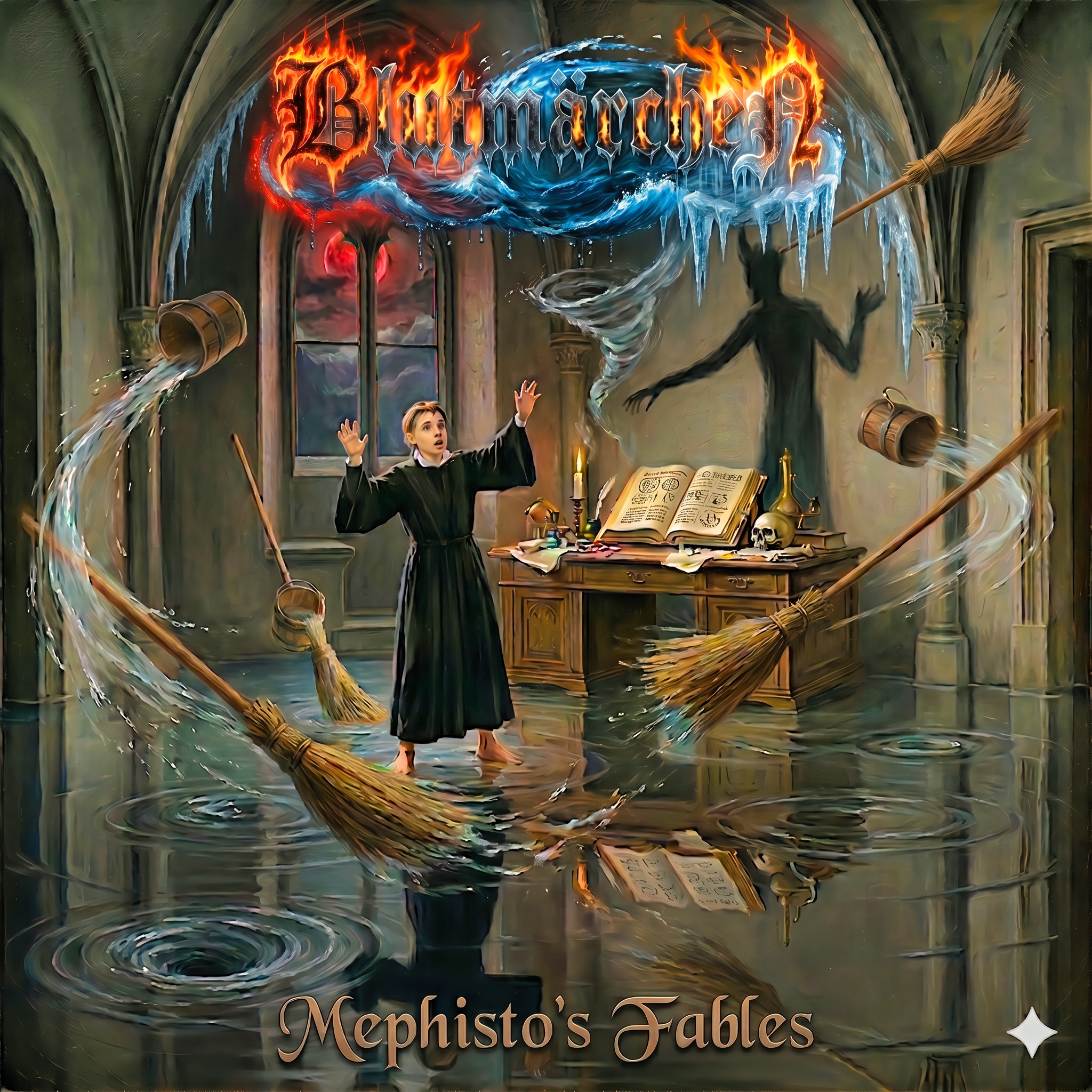
Blutmärchen
Twenty fables — told by the Devil himself. From Faust's first deed to Descartes' last doubt — Every hand that reached beyond its calling. Only the mind that asks survives the telling.
Ceci tuera cela — das Buch wird das Gebäude töten.— Ceci tuera cela — the book will kill the building.
Victor Hugo's line about the printing press killing the cathedral, sung from inside the cathedral by the figure no one will save. Ceci tuera cela. This will kill that. Hugo meant the book would replace the building. The song lets Quasimodo answer.
The structure is operatic and bilingual on purpose: growled English verses for the bell-bearer, soprano Latin choruses for the soul he names through every bell. I learned the world through stone and sound, a crooked child the bells had crowned. The cathedral is not a stage — it is his body, his alphabet, the only language his deformity was given. Non sum monstrum sed amor. Not a monster but love. Sub cruce vivo fideliter. Under the cross, I live faithfully.
The song's larger turn is the title's reversal. Hugo argued the book would replace the church. The bell-bearer argues something the printing press cannot replace: I guard the flame they threw away. A living bell they would not pray. The cathedral is not the building. It is the labor of the one no one looked at. Mephisto would buy the printing press. He has no use for the bell-bearer's love.
English
“Ceci Tuera Cela (The Bell-Bearer’s Lament)”
Prologue – SPOKEN (French, whispered)
Citation – Victor Hugo
« Les grands édifices, comme les grandes montagnes, sont l’ouvrage des siècles. »
Intro – CHOIR (Latin, slow, 8 syllables)
Cla-mant cam-pa-nae no-ctis
La-pis can-tat cor fra-ctum
Verse I – GROWLS (English, 10–11 syllables)
I learned the world through stone and sound (10)
A crooked child the bells had crowned (10)
Their bronze became my breath and bone (11)
A tower’s heart… my flesh, my throne (10)
Verse I – SOPRANO (Latin, legato, 12 syllables)
Sub ar-cis ve-te-ris do-lor can-tat
A-ni-ma lu-cet in te-ne-bris
Pre-Chorus – CLEAN MALE (English, 8 syllables)
You fear the mirror of my face
Yet kneel to gold and call it grace
Chorus I – SOPRANO (English, 12 syllables)
I see the light you cannot bear
A soul outshines the shattered air
If love is weighed by scars we keep
Then mine is deep enough to weep
Chorus I – GROWLS (Latin, underlay, 8 syllables)
Mi-se-re-re cor-de me-o
Non sum mons-trum sed a-mor
Interlude – SPOKEN (French, distant)
Citation – Victor Hugo
« Ceci tuera cela. »
Verse II – GROWLS (English, 10–11 syllables)
They named me beast to sleep at night (10)
Blind to their own deforming sight (11)
I guard the flame they threw away (10)
A living bell they would not pray (11)
Verse II – SOPRANO (Latin, 12 syllables)
A-mo-re sal-va quod con-tem-nunt
Sub pon-de-re car-nis cor man-et
Chorus II – SOPRANO (English, 12 syllables)
O hear the bells of broken grace
They toll for more than time and place
Within these walls of ash and art
Still beats the flesh of Notre’s heart
Chorus II – GROWLS (Latin, 8 syllables)
Cam-pa-na plo-rat no-men me-um
Sub cru-ce vi-vo fi-de-li-ter
Bridge – SOPRANO + CHOIR (Latin)
Lu-men sub um-bra na-sci-tur
Ve-ri-tas ma-net
Ve-ri-tas ma-net
Breakdown – GROWLS (English, 8 syllables, half-time)
Ring the bells
I carry your sin
Stone shows mercy
I still give in
Verse III – GROWLS (English, 10 syllables)
For one pure flame I bled the sky (10)
Love bent the bell, yet would not die (10)
If heaven shuns this broken frame (11)
Then let the bells remember my name (11)
Final Chorus – SOPRANO (English, 12 syllables)
If love must burn to still be true
Then let these scars ring out for you
I stand where fallen angels dwell
The soul of stone… the living bell
Final Chorus – GROWLS (Latin, 8 syllables)
Non o-dit De-us cor fra-ctum
In mor-te vi-ta re-so-nat
Epilogue – SPOKEN (French)
Citation – Victor Hugo
« Les grands édifices sont l’ouvrage des siècles. »
Outro – SOPRANO (Latin, fading, 10 syllables)
Cam-pa-na can-tat a-ni-mam
Deutsch
"Ceci Tuera Cela (Die Klage des Glöckners)"
Prolog – GESPROCHEN (Französisch, geflüstert)
Zitat – Victor Hugo
„Die großen Gebäude, wie die großen Berge, sind das Werk der Jahrhunderte."
Intro – CHOR (Latein, langsam, 8 Silben)
Die Glocken der Nacht rufen
Der Stein singt ein gebrochenes Herz
Verse I – GROWLS (Englisch, 10–11 Silben)
Ich lernte die Welt durch Stein und Klang
Ein krummes Kind, das die Glocken krönten
Ihr Bronze wurde mein Atem und Knochen
Das Herz eines Turms… mein Fleisch, mein Thron
Verse I – SOPRAN (Latein, legato, 12 Silben)
Unter dem alten Bogen singt der Schmerz
Eine Seele leuchtet in der Finsternis
Pre-Chorus – KLARER MANN (Englisch, 8 Silben)
Du fürchtest den Spiegel meines Gesichts
Doch kniest vor Gold und nennst es Gnade
Chorus I – SOPRAN (Englisch, 12 Silben)
Ich sehe das Licht, das du nicht ertragen kannst
Eine Seele überstrahlt die zerschmetterte Luft
Wenn Liebe an den Narben gewogen wird, die wir tragen,
Dann ist meine tief genug, um zu weinen
Chorus I – GROWLS (Latein, Unterlage, 8 Silben)
Erbarme dich meines Herzens
Ich bin kein Ungeheuer, sondern Liebe
Interlude – GESPROCHEN (Französisch, fern)
Zitat – Victor Hugo
„Dies wird jenes töten."
Verse II – GROWLS (Englisch, 10–11 Silben)
Sie nannten mich Bestie, um nachts zu schlafen
Blind für ihren eigenen entstellenden Blick
Ich hüte die Flamme, die sie wegwarfen
Eine lebende Glocke, zu der sie nicht beten wollten
Verse II – SOPRAN (Latein, 12 Silben)
Durch Liebe rette, was sie verachten
Unter dem Gewicht des Fleisches bleibt das Herz
Chorus II – SOPRAN (Englisch, 12 Silben)
O höre die Glocken zerbrochener Gnade
Sie läuten für mehr als Zeit und Ort
Innerhalb dieser Mauern aus Asche und Kunst
Schlägt noch immer das Fleisch von Notres Herz
Chorus II – GROWLS (Latein, 8 Silben)
Die Glocke beweint meinen Namen
Unter dem Kreuz lebe ich treu
Bridge – SOPRAN + CHOR (Latein)
Licht wird unter dem Schatten geboren
Die Wahrheit bleibt
Die Wahrheit bleibt
Breakdown – GROWLS (Englisch, 8 Silben, halbes Tempo)
Läute die Glocken
Ich trage deine Sünde
Stein zeigt Gnade
Ich gebe noch immer nach
Verse III – GROWLS (Englisch, 10 Silben)
Für eine reine Flamme blutete ich den Himmel
Liebe beugte die Glocke, doch sie wollte nicht sterben
Wenn der Himmel diesen gebrochenen Rahmen meidet,
Dann mögen die Glocken meinen Namen erinnern
Final Chorus – SOPRAN (Englisch, 12 Silben)
Wenn Liebe brennen muss, um noch wahr zu sein,
Dann lass diese Narben für dich erklingen
Ich stehe, wo gefallene Engel wohnen
Die Seele aus Stein… die lebende Glocke
Final Chorus – GROWLS (Latein, 8 Silben)
Gott hasst kein gebrochenes Herz
Im Tod hallt das Leben wider
Epilog – GESPROCHEN (Französisch)
Zitat – Victor Hugo
„Die großen Gebäude sind das Werk der Jahrhunderte."
Outro – SOPRAN (Latein, verklingend, 10 Silben)
Die Glocke singt die Seele
- Artist
- Blutmärchen
- Song title
- IX — Ceci Tuera Cela (The Bell-Bearer's Lament)
- Album
- Mephisto's Fables — From the first deed to the last doubt
- Released
- 2026
- Genre
- Symphonic melodic death metal
- Country
- Luxembourg
- Label
- Self-released
- Rights
- © 2026 Blutmärchen — All rights reserved
Composed with AI-assisted arrangement (Suno, licensed for commercial use), performed and produced under human direction. Full disclosure →
Want to contribute a real performance to a future tale? Read the call →